> For the complete documentation index, see [llms.txt](https://help.arcanalabs.ai/learning-center/llms.txt). Markdown versions of documentation pages are available by appending `.md` to page URLs; this page is available as [Markdown](https://help.arcanalabs.ai/learning-center/demos-and-tutorials/arcana-filmmaking-process.md).
# Arcana FilmMaking Process
Anyone can produce stunning movies if they learn these basic workflows. The objective is to achieve quality, aesthetic control, character consistency, and guided shot selection.
## OVERVIEW:
1. Train Models for your World and your Characters
2. Use X-Ray to turn Storyboards into Image Assets
3. Use Transform to turn image assets into your world's aesthetic
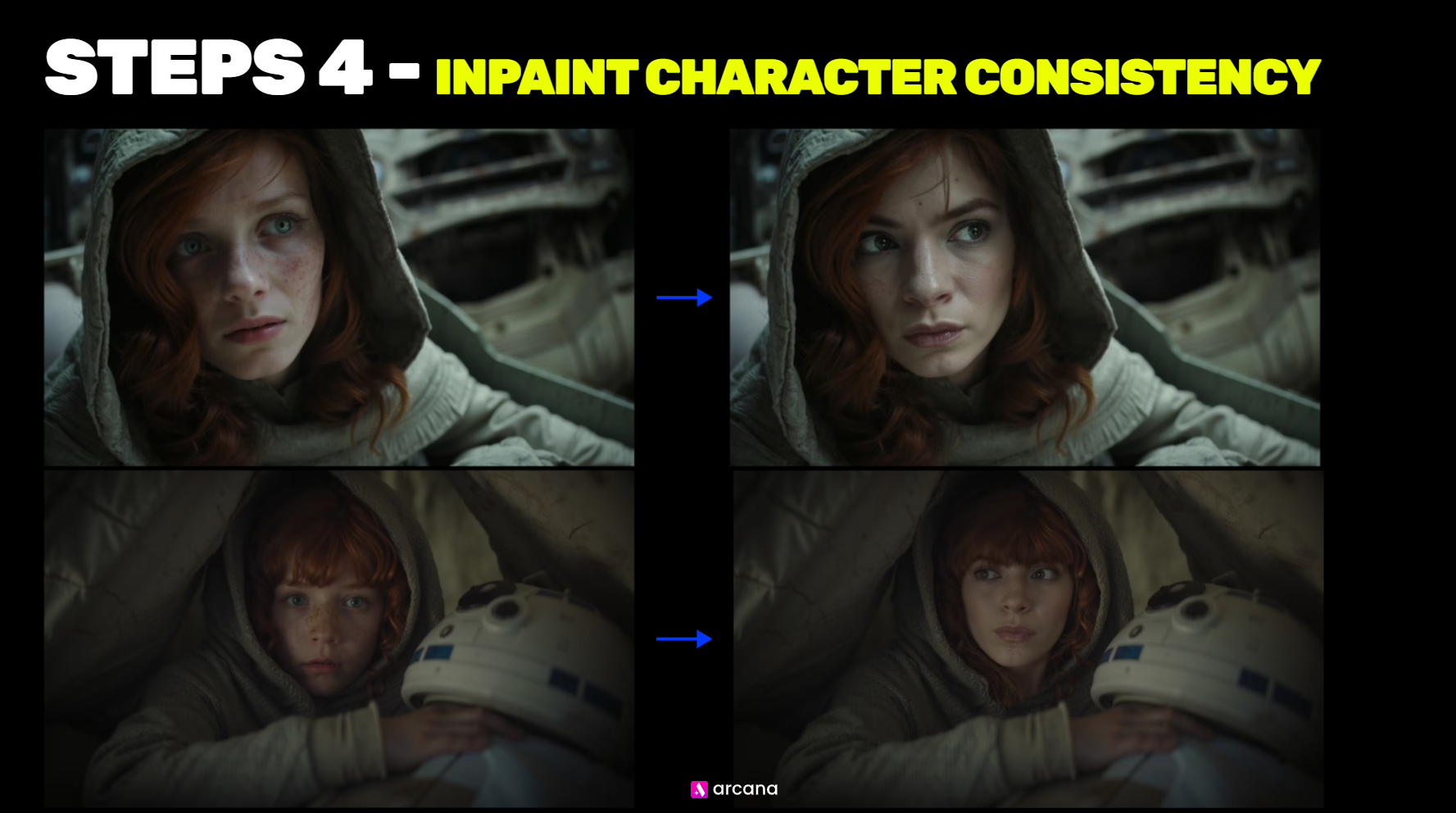
4. Inpaint your assets with your character specific models for character consistency
5. Send images to Motion Tab
{% embed url="" %}
From Storyboard to X-Ray Generated Images to Final Video
{% endembed %}
## STEP 1 - Model Training
Go select CREATE YOUR OWN MODEL:
For a MOVIE you need at least TWO Models. One trained on your world and Aesthetic, and another trained on a specific actor you want to cast. Without the latter you cannot achieve character consistency, and without the former you cannot create visual consistency across your shots.
## STEP 2 - Using X-Ray to turn Storyboards into Image Assets
Upload your storyboard into X-Ray (soft, sharp or ultrasharp), prompt what you want to see, don't be precious about the output image just make sure it's accurate enough so you can transform it in step 3.
## STEP 3 - Using Transform to turn image assets into your world
Play with transformation strength between 45%-75%. Make Sure you select your WORLD MODEL that you custom trained. Don't be afraid to iterate on the image with smaller transformation strength until you are happy.
## STEP 4 - INPAINTING FOR CHARACTER CONSISTENCY
SELECT your CHARACTER MODEL and begin inpainting the faces. Usually 65-81% transformation strength gets you home. Iterate until happy.
## STEP 5 -SEND IMAGE TO MOTION TAB
1. Drag your image to motion, or select the motion button to send it to Motion (duh lol)
2. Select the Motion Video Model You Want (We love kling)
3. Select the Creativity Level (we tend to stick to default 0.5 but increase if facing prompt adherence issues)
4. Prompt what you want to see (e.g. CAMER PUSH IN, Character walking, etc...)
5. For best practices do at least 4 generations and cherry pick your favorites
## VIDEO TUTORIAL
{% embed url="" %}
## GALLERY OF RESULTS
{% embed url="" %}
Click to play
{% endembed %}
{% embed url="" %}
{% embed url="" %}
{% embed url="" %}
---
# Agent Instructions
This documentation is published with GitBook. GitBook is the documentation platform designed so that both humans and AI agents can read, navigate, and reason over technical content effectively. Learn more at gitbook.com.
## Querying This Documentation
If you need additional information that is not directly available in this page, you can query the documentation by asking a question.
Perform an HTTP GET request on the following URL with the `ask` and `goal` query parameters:
```
GET https://help.arcanalabs.ai/learning-center/demos-and-tutorials/arcana-filmmaking-process.md?ask=&goal=
```
`ask` is the immediate question: it should be specific, self-contained, and written in natural language.
`goal` is what the user is ultimately trying to achieve, the reason they need the answer. Sharing it helps GitBook give you a better, more relevant answer. A goal is most helpful when it describes the outcome the user wants rather than restating the question. For example, with `ask=how do I create an API token`, a goal like `automate deployments from our CI pipeline` lets GitBook tailor the answer to that use case.
The response will contain a direct answer to the question and relevant excerpts and sources from the documentation.
Use this mechanism when the answer is not explicitly present in the current page, you need clarification or additional context, or you want to retrieve related documentation sections.